The Tricycle Model invites educators to consider learning through three connected dimensions: what learners know and understand, their feelings and attitudes toward learning, and their development through practical activity and coordinated movement.
These dimensions provide reflection prompts. They should not be used to assign fixed labels to learners or to diagnose a condition.
The Cognitive dimension concerns thinking, knowledge and understanding. Educators may reflect on how learners explain ideas, make connections, solve problems and use what they have learned.
Questions to explore:
The Affective dimension concerns feelings, attitudes and values in relation to learning. It is broader than emotional wellbeing alone and can include interest, willingness to participate and responses to learning experiences.
Questions to explore:
Do not infer a diagnosis or a learner’s internal feelings from appearance alone. Ask, listen and use appropriate professional judgement.
The Psychomotor dimension concerns skills involving movement, coordination and practical activity. It should not be reduced to general health or physical wellbeing.
Questions to explore:
A learning activity can involve more than one dimension. For example, a practical demonstration may require understanding instructions, willingness to participate and coordinated action.
Considering the dimensions together can broaden a teacher’s questions. It does not require every lesson to allocate identical time to all three areas or provide a formula for guaranteed attainment.
Suppose a learner is finding a practical activity difficult. Rather than assuming there is one cause, an educator can ask:
Choose an appropriate support, observe what happens and review with the learner. Use this example to guide a conversation, not to diagnose or score a learner.
The Tricycle Model is an educational framework. It is not a medical, psychological or developmental assessment and does not replace safeguarding procedures or specialist advice.
Related educational ideas should be distinguished from direct evaluation of the named model. This page does not claim that the Tricycle Model is scientifically proven or guarantees measurable improvement.
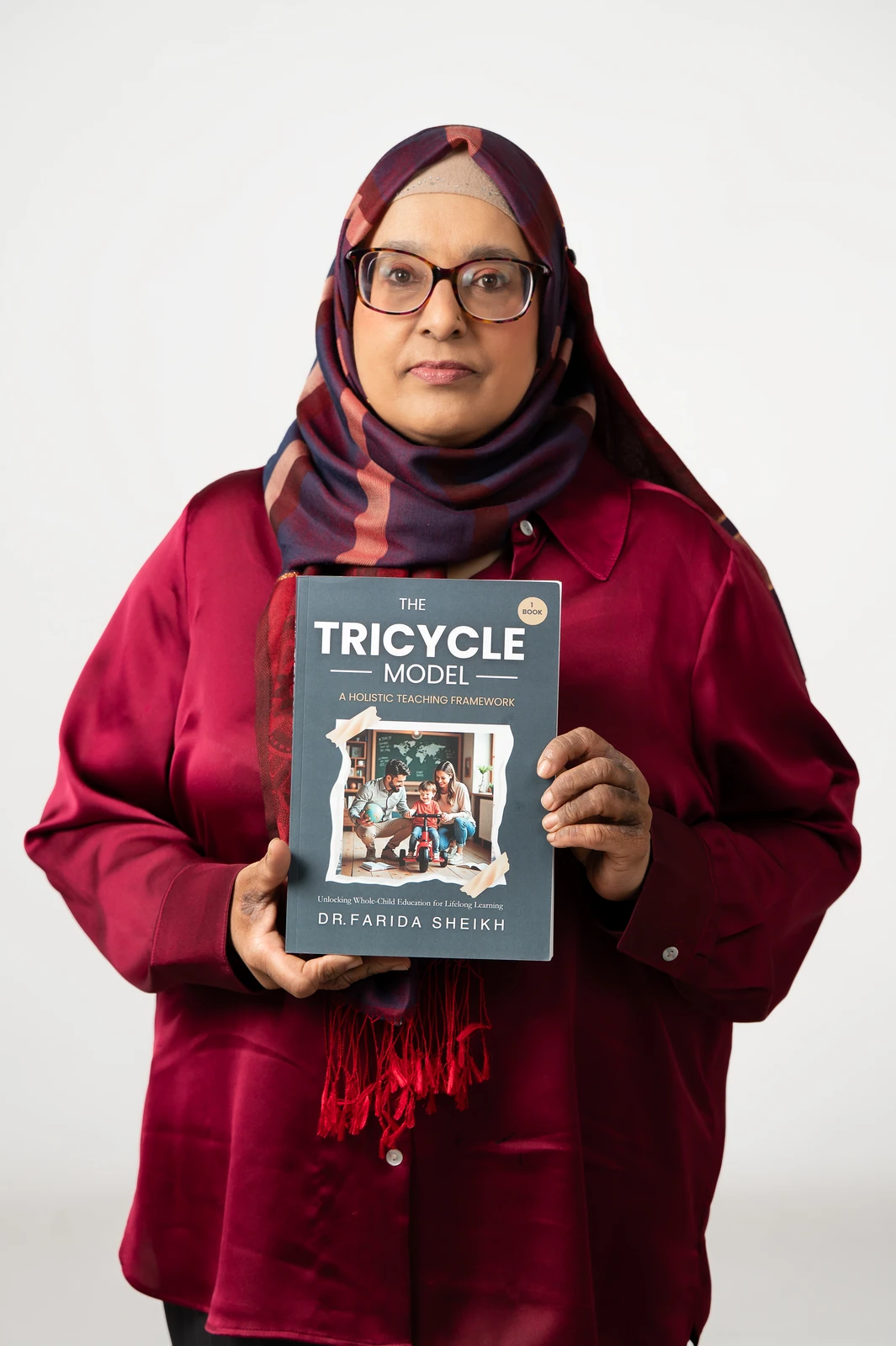
Asjad Sheikh is its original creator, developer and IP owner. Dr Farida Sheikh presents, interprets and applies it in her 2025 book.
Cognitive, Affective and Psychomotor development. These are the three connected dimensions of the model.
No. Psychomotor development concerns movement, coordination and practical skills. Physical wellbeing is a wider concept; it is not another name for this dimension.
No. It can inform educational reflection, but it is not a diagnostic tool.
Contact RVA about discussing the Tricycle Model in your educational setting or relevant professional-development programme.